
Connecticut Resident Lookup Records
Connecticut's resident records answer different questions, and no single public roll covers everyone who lives here. An assessor lists recorded owners, courts index case parties, vital records document events, and SOTS offers each voter a self-status check. Treat one match as a lead, then confirm it with a second source.
| Record | What It Confirms | Where | Access |
|---|---|---|---|
| Assessor and CAMA | Recorded owner, parcel and tax mailing address | Local assessor or OPM | Local fields vary; owner is not occupant. |
| Land deed index | Transfer parties and legal description | Town Clerk or Town Clerks Portal | Index, image and copy access varies by town. |
| Voter status | One voter's registration and polling place | Secretary of the State lookup | Self-check; $300 file has strict use limits. |
| Court case | Party, docket, case type, status and dates | Judicial Branch or courthouse | Documents and closed files follow separate rules. |
| Vital record | Birth, death or marriage event | Town or State OVR; State Library index | Birth records close for 100 years; eligibility varies. |
| License or business | Credential, entity, agent or filing address | eLicense or Business.CT.gov | Filing addresses may be old or commercial. |
Start at the assessor for ownership, the court for a case, or the vital index for a family event. None proves current residence.
Verifying a Connecticut Resident
Names repeat, change through marriage, and appear with different initials. Connecticut records sit with towns, state offices and courts, so log each search date, name form, town, parcel or docket, and what the result confirms. A voter checks their own status; an assessor connects an owner to a parcel. Neither proves a full identity.
- Start with the full name and known town. Where allowed, search the assessor and note parcel, situs and mailing address separately.
- Use the parcel to find the deed in that Town Clerk index. Compare both parties and dates; a deed shows a transfer, not occupancy.
- Search court routes with name variants. Compare docket, location, party role and dates before treating it as the same person.
- Check a vital index or other source for a family link. Request a certified copy only if eligible.
- Docket
- A case number and record of filings, parties, dates and status.
- Index and image
- An index is a search entry; an image shows the document. Images or clerk copies may cost money.
- Certified copy
- A copy authenticated by the custodian; an index result is only a pointer.
For household history, use the Connecticut city directory collections to compare names and dates.
Connecticut Resident Lookup Court Search
Connecticut's Judicial Branch has separate routes by case type. The party search requires a last name; a docket number goes straight to a known case. Options vary by module.
| Field or control | Type | Required | Use |
|---|---|---|---|
| Party Last Name | Text | Yes for party search | Use surname or first three letters if unsure. |
| Party First Name | Text | No | Use a name or initial, or omit it. |
| Docket Number | Text | Yes for docket search | Direct case selection when the number is known. |
| Case category | Filter | No | Other case types use separate routes. |
| Court location | Filter | No | Narrows by district or location. |
| Case status | Filter | No | May separate pending and disposed cases. |
| Sort order | Dropdown | No | Available choices depend on the case module. |
| Court events | Tab | No | Events by date, number, docket or location. |
| Property address | Search module | No | E-Services offers this for some property-related matters; availability varies. |
The current route depends on the case module. Check the docket detail because a name match may be unrelated.
Connecticut Court Records Results
A Connecticut court result shows a name as filed, not a full identity or official criminal-history report. Public details can omit sealed, erased, juvenile and protected information. This is the officially documented result schema, not a named-person example; the clerk who created the record handles corrections and official copies.
Public result details can include:
- Party name as filed, docket number, category and court location.
- Case history, party roles and attorney names.
- Motions, pleadings, objections and scheduled dates.
- Status or disposition shown in the public index.
For a view of the public search interface, the Connecticut Civil Inquiry portal shows the route into eligible case details.
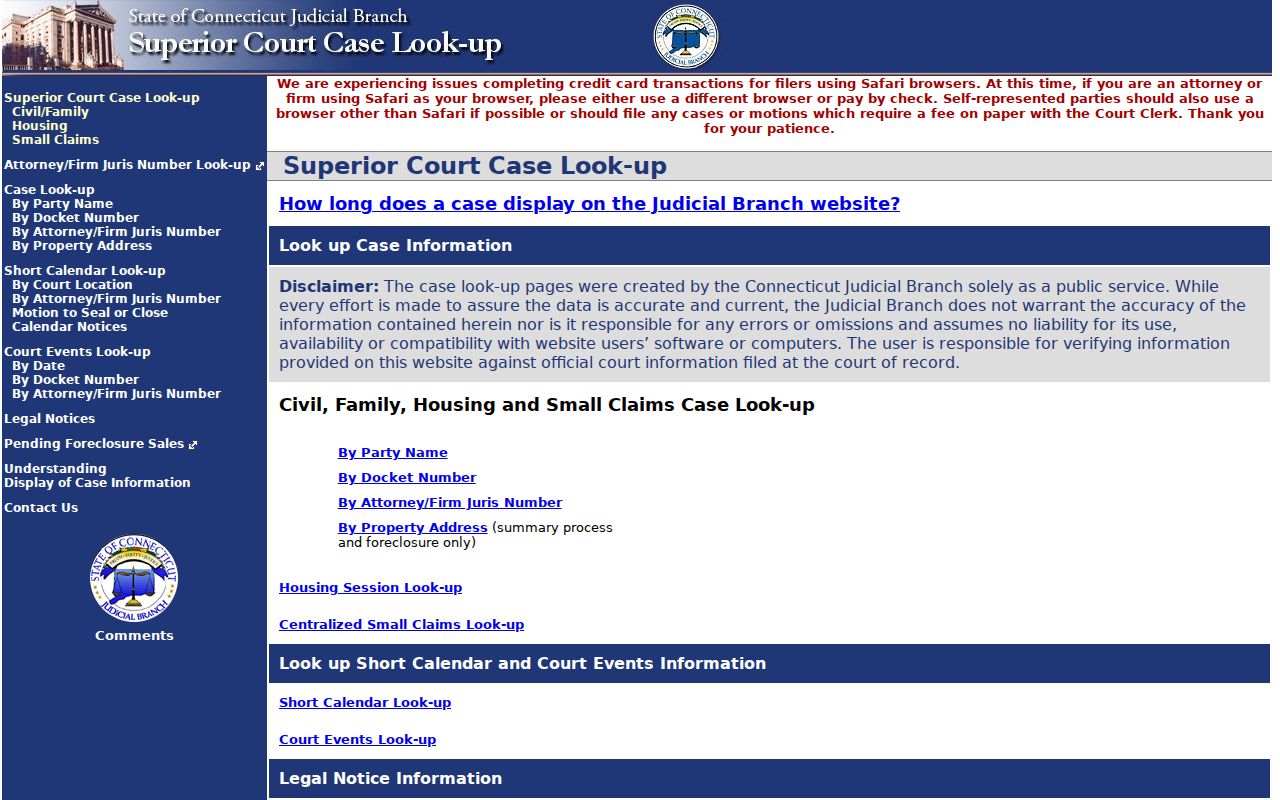
The public result may be only an index entry. The official court record and any restricted file remain with the clerk.
Online document dates are limited: civil matters with return dates from January 1, 2014, and small-claims files dated from October 16, 2017, have online access under the inspected rules. Older files may require a courthouse terminal or clerk. Family documents generally require the judicial district clerk or courthouse terminal; protected material stays closed.
Connecticut Resident Vital Records
Connecticut keeps statewide birth, death and marriage registries from July 1, 1897 forward. Before that date, the town where the event occurred is the custodian, while State Library indexes and historical collections can point to a likely record. Local registrars serve the state's 169 municipalities. A birth record is confidential until it is 100 years old. For a newer birth, eligible requesters include the adult registrant, certain close relatives, an attorney or authorized agency, and qualifying members of a Connecticut genealogical society.
The Connecticut DPH birth-record page lists proof of identity and eligibility rules. A state-issued birth copy costs $30; a town-issued copy costs $20. A person age 18 or older may obtain a death or marriage certificate subject to the stated privacy limits, and a death certificate's Social Security number is protected. Town applications are often quicker; State OVR processing can take up to twelve weeks. VitalChek is the only approved third-party ordering service and adds vendor fees.
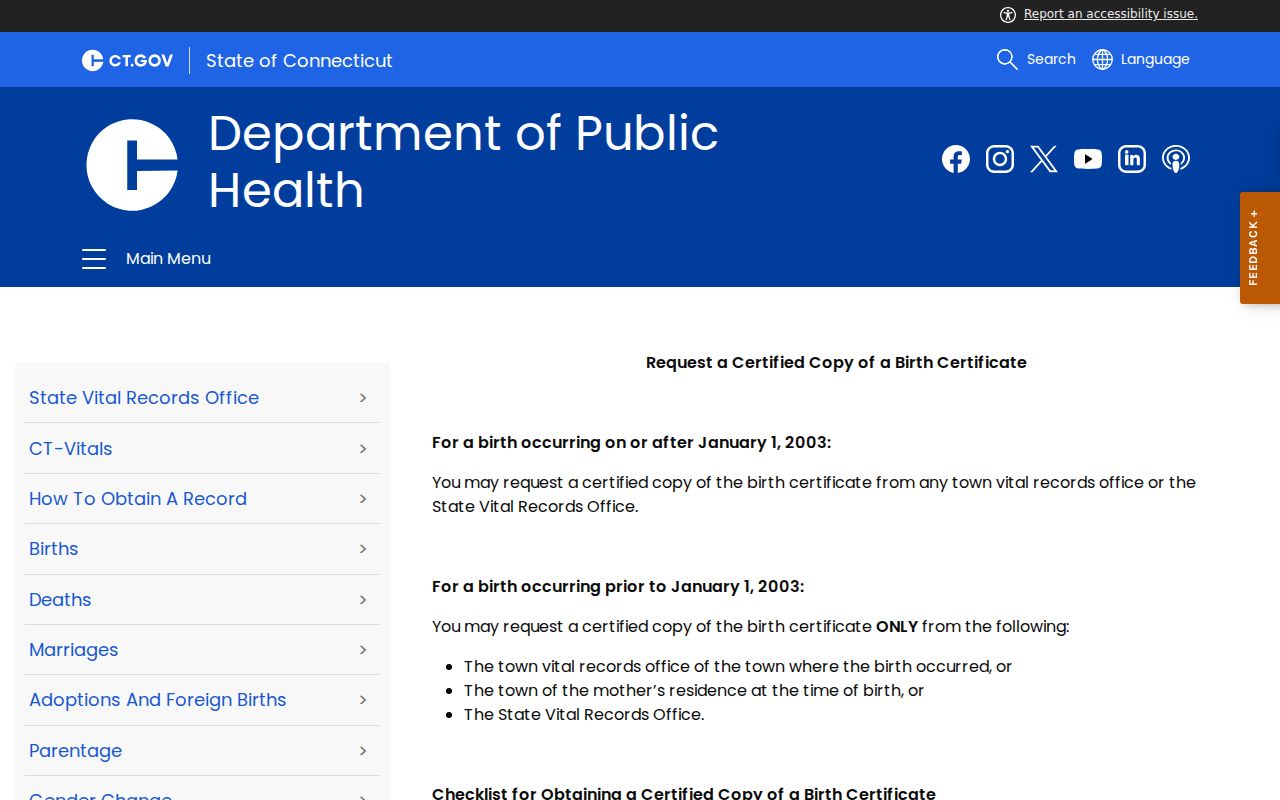
Match an index entry to the right person before paying for a certified copy, and send the application to the town or state office that can issue it.
Adoption, parentage, surrogacy and certain amended files are confidential exceptions. Use the official DPH or authorized court process for those records; a public search is not a substitute. DPH request instructions list mail, in-person and approved online routes, along with the required form and payment method.
Connecticut Resident Voter Records
The Secretary of the State tool lets a voter check their own current registration and polling place. It has no public browse-by-street mode. A town registrar can explain how to correct a voter's status.
Use the official voter information page, which links to “Look Up My Voter Registration and Polling Place.”
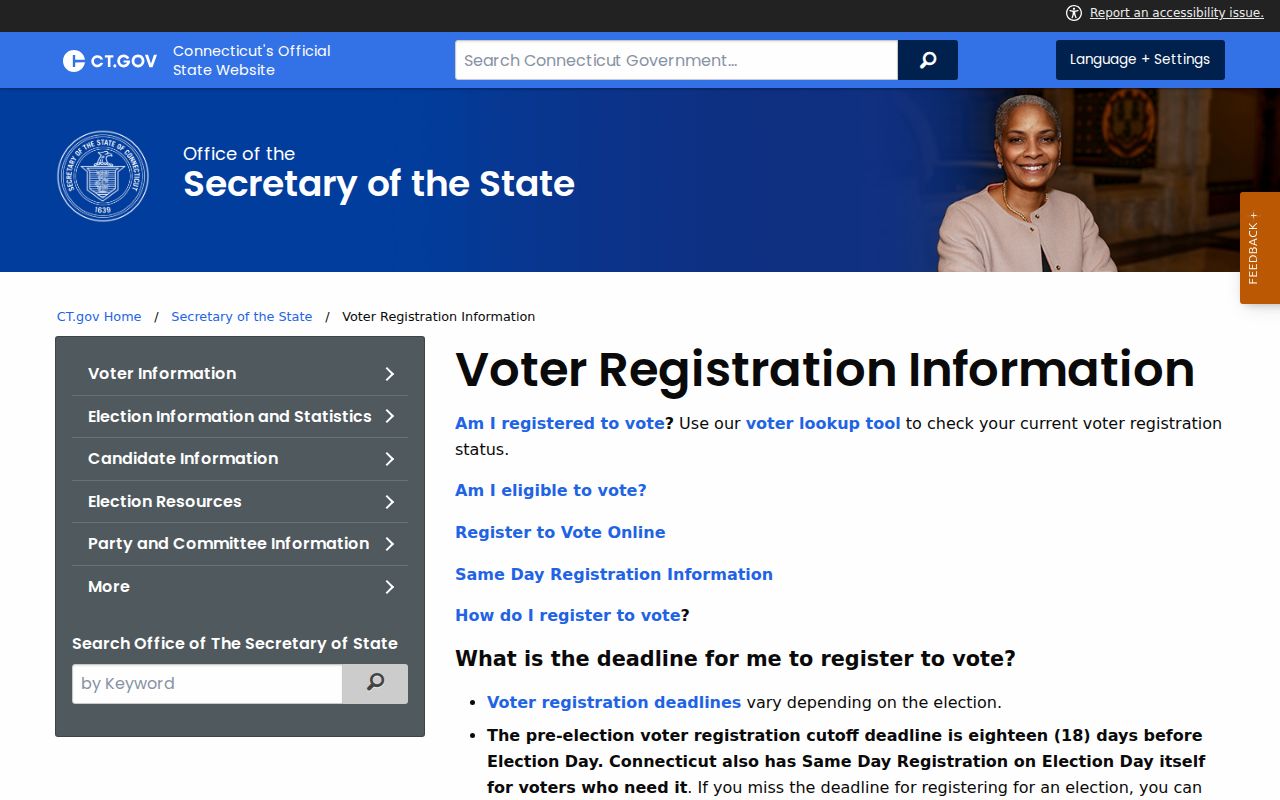
The SOTS lookup is an individual self-check. Its linked official page explains where a voter can confirm registration and polling information.
A separate statewide voter-registration CSV costs $300 and must be requested in writing. The allowed uses are election-related, scholarly, journalistic, political or governmental. The file cannot be used for personal, private or commercial purposes, advertising, solicitation or harassment, so it is not a general resident list. Released data may include name, residence, party, status, year of birth and participation history, but not ballot choices or month and day of birth. Connecticut's Public Act 26-1, section 96, exempts those birth-date details. In January 2026, SOTS said the state had declined a federal request for a more sensitive full voter file.
Resident Lookup for Connecticut Heirs
For someone who has died, probate records can identify an estate, fiduciary or family link. Search by decedent name, then review open petitions, appointments, inventories and notices. Compare a property reference with the deed index and use an obituary as a separate lead. File access varies.
- Search the likely probate district by full name and variants.
- Note the estate number, fiduciary and property reference; ask the clerk about access.
- Compare a property clue with a deed or assessor entry in its town.
- Use a yearbook, newspaper or obituary as a historical lead, not a current address.
For a former classmate, Connecticut yearbooks, newspapers and obituaries are useful leads. The State Library's genealogy guides point to probate, census and archive sources. Birth-parent searches must use DPH's official process because those files are confidential.
Connecticut Resident Business Records
A credential or business filing confirms a public affiliation, not a person's daily role or current residence. Connecticut eLicense searches by license type, number, status, name and address. Results may show credential dates, status, mailing address, scope or supervisor.
The public eLicense search accepts these optional controls; DCP advises starting with one or two fields to keep the result set useful.
| Field | Type | Required | Notes |
|---|---|---|---|
| License Type | Dropdown | No | Select the credential category. |
| Type Prefix | Dropdown | No | Narrows by credential prefix. |
| License Number | Text | No | Direct credential lookup. |
| License Status | Dropdown | No | Active, Pending or Inactive. |
| Business / DBA / Nickname | Text | No | Matches a business, assumed name or nickname. |
| First and Last Name | Text | No | Either or both name fields. |
| Address fields | Text | No | City, state, ZIP and country. |
| Search | Button | Yes | Runs the selected query. |
| Details | Result link | No | Opens credential dates and scope where available. |
eLicense verifies credentials; Business.CT.gov shows entities, filing history, principals and agents. Many electronic filings are free to view, but records older than fifteen years may not appear online. Local clerks hold trade names; UCC searches require the debtor's exact legal name.
Connecticut Privacy in a Resident Lookup
Connecticut's Safe at Home Address Confidentiality Program serves eligible people who moved or plan to move because of a safety risk; it assigns a substitute address and forwards first-class mail. The separate Voter Registry Privacy Program lets anyone swear under penalty of perjury that disclosure endangers their safety or family. Certain officials may seek address redaction under C.G.S. §1-217. Each route has limits and does not erase every public address.
Driver data is protected by state law and the federal Driver's Privacy Protection Act. Sealed, erased, juvenile, adoption and family records also have limits. For covered businesses, the Connecticut Data Privacy Act (CTDPA) provides rights to access, correct or delete personal data and opt out of sale, targeted advertising and certain profiling. Covered controllers must honor universal opt-out signals; the law does not erase the public record held by its custodian.
Connecticut FOIA and Lookup Limits
Connecticut's Freedom of Information Act, C.G.S. §§1-200 through 1-242, permits requests for existing non-exempt records. Section 1-210 covers access; section 1-212 covers copies and fees. Name the office, record, person or parcel, date range and format. Agencies commonly respond within four business days, but the rule is prompt access, not one fixed deadline. The Freedom of Information Commission hears access appeals.
FOIA does not make an office create a resident list or run a custom search. Ask for an existing record and use its custodian to correct an error or issue a copy. Stop when the record is sealed, confidential or protected.
Lawful personal use. Connecticut records support family history and civic research. Stalking, threats or harassment can violate state law; respect safety protections and do not expose a protected address.
For the access rule, see the Connecticut FOIA text. It keeps public access tied to existing records and preserves exemptions for information protected by state or federal law.