
How to Find Connecticut Residents
Finding a person in Connecticut works best when the search begins with a town and a clear question. Connecticut has 169 municipalities, and each Town or City Clerk is the local recorder for land records and many town filings. There is no active county recorder to search instead. A person may appear in one source as a property owner, in another as a voter, and in a third as a party to a court case. Those entries answer different questions. None is a complete roll of the people who live in Connecticut.
For a current address question, start with the town assessor or parcel map, then check an official record that fits the person or event. For an older household, ask a library or the Connecticut State Library for a directory, census, newspaper, or town record. Keep the town name with every result. A road may cross a municipal line, and a postal city name does not always tell you which clerk keeps the deed.
- Identify the Connecticut town or borough from the known address, and use the state town list if the municipality is not clear.
- Search that town's assessor by address, parcel, or owner name, then note the situs address and tax-mailing address separately.
- Use the Connecticut voter lookup only to check a person's own registration status; it is not a public street roster.
- Search the town clerk's deed index by the recorded parties, then use a library or archive for older directory years.
- If an online index stops short, ask the record custodian about its counter, phone, mail, or public-record request route.
Connecticut's online results are leads to verify. A deed documents a recorded transfer, a voter entry concerns election administration, and a library directory captures a particular year. A missing result may reflect a town boundary, an old spelling, a portal cutoff, or a protected record.
Connecticut's Resident Records Offices
Connecticut divides the record trail between local offices and state custodians. The state's historical counties still help with archive and census labels, but they do not operate county recorder offices. Use the municipality for deeds, assessors, permits, voter registration, and many vital records; use a state office for records held across towns. The official Connecticut town directory is a practical way to find the right municipal contact.
Town and City Clerks
Local deeds, maps, trade names, and town records
Choose the municipality first
Contact details vary by town
Connecticut town directory
State Library and Archives
History and Genealogy reference
231 Capitol Avenue, Hartford
(860) 757-6580
Department of Public Health
State Vital Records Office
Statewide registry and request forms
Town offices also hold local copies
Secretary of the State
Voter status and election records
Statewide information, town-based registration
(860) 509-6100
Voter registration information
To find the clerk, assessor, registrar, or library for a particular place, use the official Connecticut cities and towns directory.
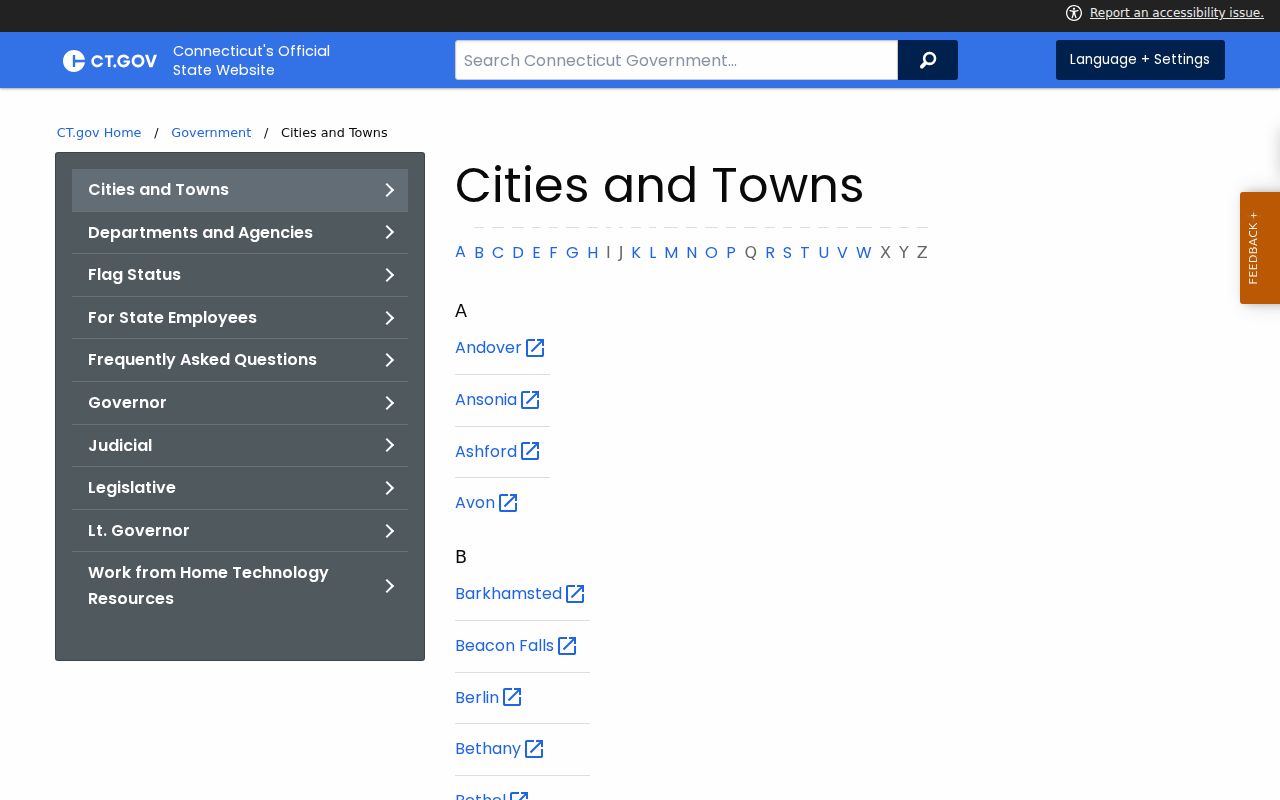
The town list helps identify the municipal office that controls the next search step.
Connecticut's State Library in Hartford is open weekdays from 10 a.m. to 4 p.m.; contact the reference desk before a trip because some off-site records may be unavailable during shelving work. Town offices set their own hours and copy rules. Ask for the specific index, year, or map you need, rather than a general list of residents.
Connecticut Residents and Parcel Search
A Connecticut parcel record is often the best bridge from a street address to a named owner. Each municipality keeps its own Grand List and assessor system. The statewide OPM Parcel and CAMA project joins town parcel files and standardized property data, but OPM warns that accuracy and completeness vary by regional Council of Governments and municipality. It is a cross-town discovery layer, not a promise of a current owner-name search for every town.
| Assessor field | Search type | How it helps |
|---|---|---|
| Owner name | Text or autocomplete | Try surname and entity or trust forms where a town portal supports them. |
| Street number and name | Text or dropdown | Use the physical address; units and road-name variants can change a match. |
| Town | Required in statewide layer | Choose the legal municipality, not only the postal city. |
| Parcel or account ID | Text | Bridge a result to the map, deed, tax, and permit record. |
| Map, lot, or block | Text | Help find an older deed when the street address is absent. |
| Assessment year | Year filter | Availability varies; the assessment date is October 1. |
Separate the situs, the physical parcel address, from the owner's tax-mailing address. The mailing address may point to an out-of-town owner, trust, attorney, business, or old address. A parcel card may show values, exemptions, land use, or living units, but those fields vary by town and do not list every person at the property. The OPM Parcel and CAMA hub explains the statewide map and data downloads.
These terms help keep a Connecticut residents directory search grounded in what the record actually says:
- Parcel
- A mapped piece of land or unit tracked by a town assessor.
- Roll
- A record list maintained for a set purpose, such as the assessor's Grand List.
- Index
- A finding tool that points to a record or image, but may not include the full document.
- Criss-cross directory
- A historical directory section arranged by street or address rather than by a person's name.
Connecticut Land Records Offices
For a deed, map, lien, or trade name, the Town or City Clerk in the property's municipality is the recorder. Connecticut has no county register of deeds. The legacy Connecticut Town Clerks Portal is migrating towns to RECORDhub, so check which system serves the town before creating a paid account. The legacy portal offers a free guest index in participating towns; its published access options include daily and monthly subscriptions, image charges, and possible payment fees. Amounts and coverage are town-specific.
When an image is not online, use the clerk's public terminal or ask for a counter or mail copy. A phone call can confirm which years are indexed and whether an old book is available. A focused request should name the town, parties, instrument type, date range, and book or page if known. Bristol's official example reaches images back to March 22, 1787, but that is not a statewide cutoff.
Connecticut's portal transition is a useful reminder that an online blank can mean a town has not moved, an image is not included, or a name was indexed differently. The Street Directory page follows this chain in more detail.
Current Connecticut Resident Directories
Connecticut does not maintain one public list of everyone who lives in the state. The useful current sources are narrower: an assessor links a property owner to a parcel, a voter tool checks an individual's registration, and court or license records show an official interaction. Treat each source according to its purpose and access rules.
| Connecticut source | What it can show | Custodian | Route |
|---|---|---|---|
| Grand List and assessor card | Owner, parcel, mailing and situs fields | Municipal assessor | Town portal, counter, or record request |
| Voter status lookup | One person's current registration and polling place | Secretary of the State and registrar | Individual online lookup |
| Deed and lien index | Recorded parties and instruments | Municipal Town or City Clerk | Town portal, public terminal, or copy request |
| Judicial Branch case lookup | Public case identity, parties, and status | Connecticut Judicial Branch | Online index and courthouse terminals |
| Professional license search | Credential, status, and listed contact fields | Department of Consumer Protection | eLicense public verification |
| Commercial address profile | Compiled records from mixed sources | Private data providers | Often a paid report; verify at the official custodian |
Connecticut assessor, voter, and court records do not prove the same thing. A listed property owner may live elsewhere; voter participation does not disclose ballot choices; and a court case is not a current-address confirmation. Commercial address profiles can combine these kinds of data, but may merge people with the same name or keep an old address. Check the original town, state, or court record before relying on a match. Public staff directories and association contact pages can help locate a custodian or group, but they are not resident rolls.
Connecticut Voter Records and Residents
The Secretary of the State links to an online tool for a person to check their own registration and polling place. It does not let the public browse every registered voter on a Connecticut street. Town registrars maintain the official local registry through the statewide system, and a counter visit can help with a person's status or correction process.
A separate statewide file requires a written request to the Secretary's LEAD office. The delivered file is CSV only, costs $300, and is limited to election-related, scholarly, journalistic, political, or governmental use. The form asks for requester and mailing details, payment, and a use certification. It is not an open resident list. Released fields can include name, residence, town, party, status, year of birth, participation history, and precinct information; month and day of birth are withheld under current state law. Protected voters are suppressed.
Connecticut's voter registry privacy program and Safe at Home address program provide separate protections. A blank or omitted address may be a legal safeguard, not a data error.
Connecticut Court Records for Names
Connecticut Judicial Branch search routes cover several court types, but the forms differ. A party-name search needs a last name; when spelling is uncertain, the guidance says a first letter or first three letters can return a broader list in E-Services. Start with the Judicial Branch case gateway or the case-specific portal, then record the docket number and court location before deciding that a match belongs to the person you seek.
| Search control | Type | Use and limits |
|---|---|---|
| Party last name | Required text | Try the filed spelling or a short prefix when needed. |
| Party first name | Optional text | Use variants or initials to sort same-name results. |
| Docket number | Text | Direct selection when the case number is known. |
| Case category and location | Filters | Routes vary for civil, family, small claims, criminal, and appellate matters. |
| Status and court events | Filters or tabs | May show pending or disposed status, dates, and event history. |
A documented docket result may show the filed party name, case number, category, court location, parties, attorneys, events, dates, and status or disposition. The online display is not the official court file. Sealed, erased, juvenile, family, or protected-party information may be absent. For older or non-online material, use a public courthouse computer or ask the clerk for the paper file and copy process.
Historical Connecticut Resident Directories
Connecticut's city directories, town reports, newspapers, and census records can place a household in a particular year. Bridgeport's documented directory run begins in 1855 and continues through 1990; street listings start in 1895. The State Library has directory holdings from across Connecticut, but each town's run can be partial. These records show what was printed in that edition, not a person's current address.
Bridgeport Public Library's History Center holds city directories, newspapers, yearbooks, maps, and related files. The Connecticut State Library adds town documents, census material, newspapers, and archive guides. The Connecticut city directory collections page covers the historical shelf in depth. For an older address, pair a street listing with a map or town record because road names and numbers can change.
Connecticut Vital Records Access
Connecticut's 169 towns issue local certificates and keep local copies, while the Department of Public Health State Vital Records Office maintains a statewide registry from July 1, 1897 forward. Before that date, the town where the event occurred is the custodian. The State Library's indexes and historical collections can help locate older events, but they are finding aids rather than certified copies.
Requests may go through the town or state office in person or by mail. Approved VitalChek routes handle some birth, death, and marriage requests online or by phone, with vendor fees. DPH says state processing can take up to twelve weeks; town service is generally quicker. A state-issued birth certificate costs $30 and needs photo ID plus proof of eligibility. Birth records are closed until 100 years old, with limited eligible requesters. Adults 18 and older may request death and marriage certificates, subject to privacy exceptions and redactions.
For an early birth that is missing from a town book, check church registers, cemetery compilations, family papers, and newspaper notices at a library. Each can support a family history, but a notice is not a certified vital record.
Connecticut Records Request Paths
When a Connecticut record is not indexed online, ask the agency that holds it whether it can be inspected at the counter or copied by mail. Under the Connecticut Freedom of Information Act, any person may inspect or request non-exempt agency records promptly during regular business hours. A written request helps define the office, date range, person, parcel, and format, but FOIA does not require an agency to make a new resident list or conduct a custom search.
The Freedom of Information Commission says many agencies respond within four business days, but there is no one fixed deadline for every request. State agency copies generally have a 25-cent-per-page cap; municipal charges follow the statute and local schedule. Ask about electronic copies, certified copies, advance payment, and any exemption. A targeted request is more useful than asking for every record tied to a common name.
The Connecticut FOI request and fee FAQ summarizes practical steps. Its page is a starting point; the agency's custodian can explain its own form and access route.
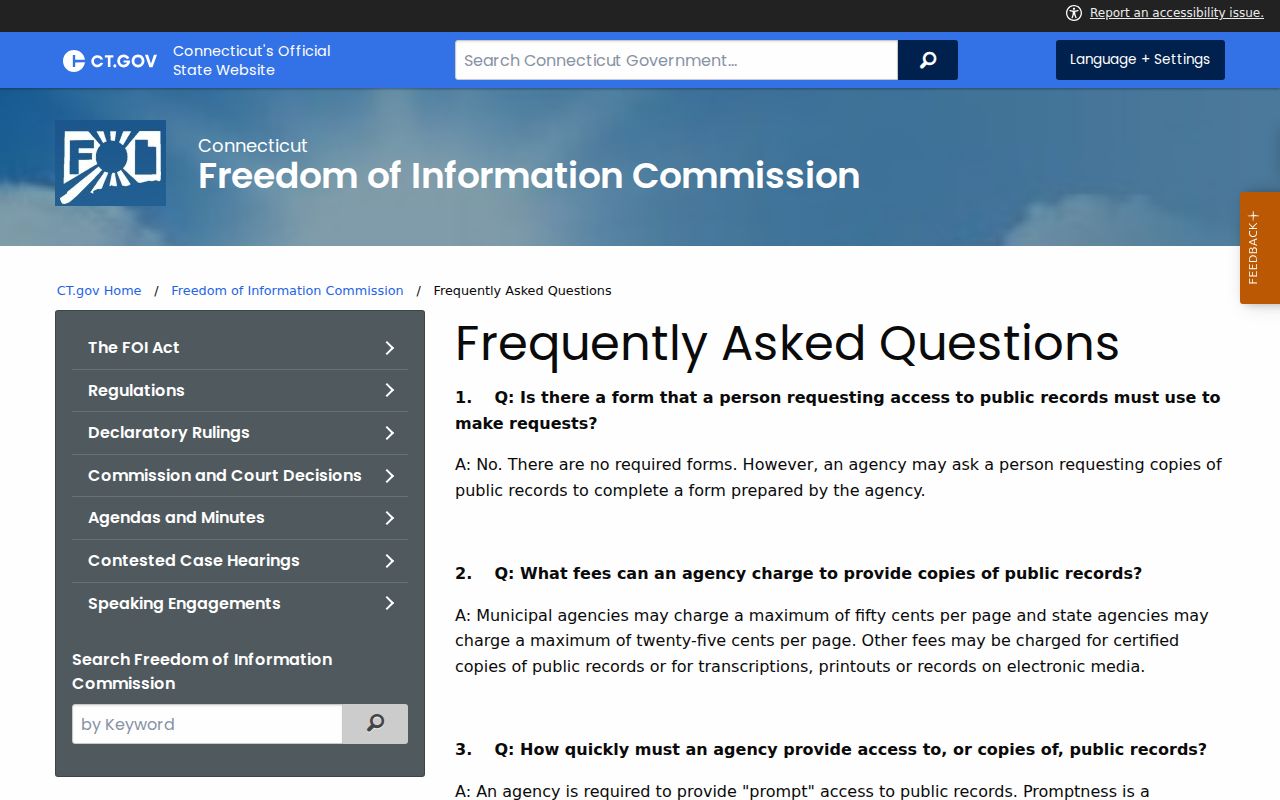
The image points to a statewide request route, while the right custodian still depends on whether a record belongs to a town, state office, court, or library.
Connecticut Custody and Registry Records
Connecticut has no single county jail roster. The Department of Correction offers a statewide current-custody search by name, DOC number, or date of birth. Its information is updated daily, covers current custody, and has legal and public-safety exclusions. It does not replace an older court file or show every person who has had contact with law enforcement.
Visit the official DOC inmate information page for its search and scope notice.
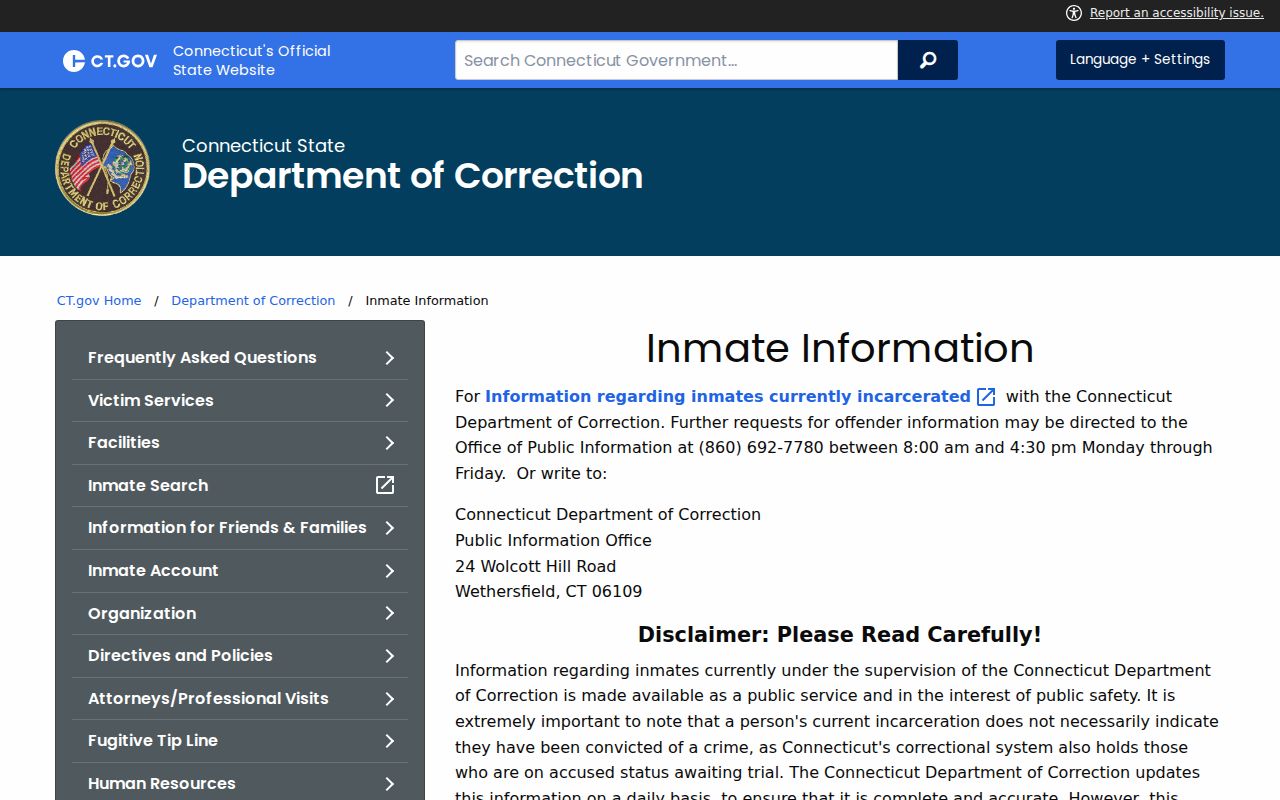
The custody search has a narrow time scope, so use the court clerk or another official record for a different question.
The Connecticut Sex Offender Registry is a separate DESPP search. A public result can show a last-known address, physical descriptors, and offense details. DESPP warns that registry information should not be treated as a risk assessment. Read the warning before using the record, and do not treat a listed address as proof of a person's current presence.
Open the official Connecticut Sex Offender Registry to see the record fields and notice.
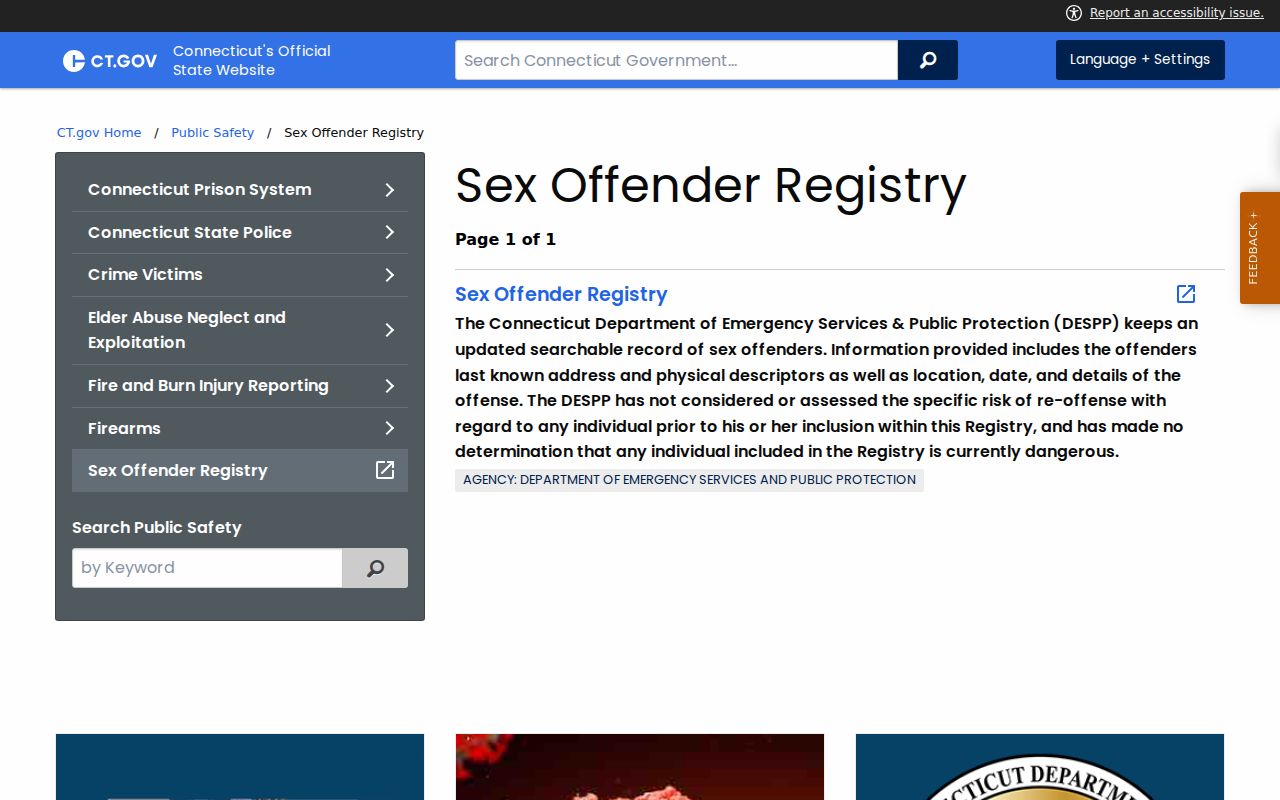
The warning matters because the registry is one limited public-safety record, not a full resident directory or a finding about a person's risk.
Connecticut License Records
Connecticut's eLicense service can help confirm whether a named professional credential is active, pending, or inactive. The Department of Consumer Protection says the public search accepts license type, prefix or number, status, name, business or DBA, and address fields. Results can include a credential number and type, effective and expiration dates, mailing address, and scope or supervisor details where relevant.
Use one or two fields first, then open the detail record and check its dates. A credential entry shows what the agency has on file; it is not proof that the person is at the listed location today. For an older licensing question or a complaint detail not shown in public results, contact DCP with the credential number.
The Business.CT.gov records search offers entity names, filing history, principals or agents, and filing addresses; some electronic images are free to view, while records older than fifteen years may not appear in that online method. A filing address connects a person to an entity, not necessarily to a residence. Local trade-name records remain with the town clerk.
Connecticut Privacy and Resident Records
Connecticut records can omit a name or address for a lawful reason. Safe at Home gives eligible people who have moved or plan to move for safety a substitute address and mail-forwarding service. The Voter Registry Privacy Program can withhold a person's voter name and address when disclosure would endanger them or a family member. These routes are separate, and the actual residential address should not be inferred from a program address.
State law also allows certain officials to ask agencies to withhold their residential addresses. The Department of Motor Vehicles does not release personal driver and vehicle data for a general lookup. If an assessor or deed display shows “Current Owner” or a parcel address in place of a person's name, that may reflect suppression rules rather than a defective record.
Personal research. Use Connecticut records for a lawful personal purpose, confirm important details with the custodian, and never use a name or address trail to stalk, threaten, or harass anyone.
The Secretary of the State explains the Safe at Home program, and Connecticut's FOI rules describe address protections. A public record remains subject to its own privacy rules even when another source displays a similar address.
Connecticut Archives and Resident Records
Connecticut town books preserve land, vital, church, and meeting history from the colonial era. The State Library became the official State Archives in 1909 and reports more than 55,000 cubic feet of holdings plus five terabytes of electronic records. This scale means an older name may be found through a catalog, finding aid, or reference request instead of a simple name box. Contact History and Genealogy staff before visiting, especially while some off-site records are unavailable.
State Library reporting describes nearly 9,000 late nineteenth- and early twentieth-century vital, probate, church, and military items scanned with FamilySearch in one year. A separate grant will add about 100,000 Connecticut newspaper pages dated 1690 to 1963 during 2026 and 2027. Search those scans alongside town directories, annual reports, cemetery guides, and local newspapers. A digitized item can make a source easier to reach, but not every Connecticut town or year is covered.
That mix of local books and statewide finding aids is the best backstop when an online Connecticut resident search comes up empty. Keep the town, record type, and year with each lead so a librarian or clerk can find the right series.